EV ownership in Thailand has grown rapidly, especially in major cities like Bangkok, Chiang Mai, and Phuket. But Thailand’s tropical climate also means frequent heavy rain, flash floods, and waterlogged roads, which are conditions that often leave EV drivers wondering: Is it safe to drive an EV in flood water?
The good news is that modern EVs sold in Thailand are built with strong waterproofing standards, and the EV battery pack is well protected. Still, waterproof does not mean flood-proof, and Thailand’s sudden deep flooding can create risks for any vehicle. Understanding how EVs behave in flood conditions helps protect both your safety and your EV battery.
Are EVs safe in flood water?
Modern electric vehicles are designed to handle rain, standing water, and wet roads without issues. Their protection levels often exceed what many people expect.
Why EVs hold up well in water
- High IP ratings: Most EV batteries and drive components meet IP67, IP68, or IP69 standards. These ratings indicate resistance to dust and water exposure, including temporary immersion.
- Waterproof battery pack: The battery is sealed inside an aluminium housing with gaskets, rubberised seals, and pressure-monitoring valves.
- Built-in fault detection: EVs constantly check for leaks or electrical abnormalities. If something goes wrong, the system isolates high voltage automatically.
- No air intake needed: Petrol cars stall in floods due to water entering the air intake. EVs don’t have this vulnerability.
This means, your EV can safely handle heavy rain, puddles, wet roads, and shallow flood water. But waterproofing doesn’t make the car amphibious. Deep or prolonged immersion is still risky, just like for petrol cars.
When you can drive an EV through water
There are situations common in Thailand where it’s still safe to drive an EV through water:
✔ Water level below the wheel hub
If the water only reaches ankle-height (typical shallow flooding on Bangkok roads), your EV can generally pass without issue.
✔ Short sections of mild flooding
Some roads in big cities like Bangkok and Chiang Mai often get shallow water after heavy rain. EVs can handle these as long as you move slowly.
✔ No strong currents
Urban flooding in Thailand is usually standing water rather than fast-moving water. If you see flowing currents, especially near canals (khlongs), avoid driving.
✔ Smooth, slow driving
EVs deliver instant torque, so avoid sudden acceleration that can splash water into sensitive areas. Maintain steady movement through the water.
✔ Familiar roads
If you are driving on streets you know well (e.g., near home or office), you already have a sense of road dips and hidden potholes. Unknown roads carry higher risk during floods.
When you should not drive an EV through floods
Thailand’s floods can rise quickly, often turning main roads into deep pools within minutes. In these situations, even a well-designed EV should not enter the water. Avoid driving when:
✘ Water is above the wheel hub
If the water reaches mid-calf or knee height, it may already be too deep. This level risks submerging electronics, cooling systems, and connectors.
✘ The water is moving or flowing
Near canals, drains, or sloped roads, water can move fast enough to push a vehicle, regardless of petrol or electric.
✘ The charging port area is submerged
While sealed, the charging port area is not intended for prolonged immersion.
✘ You cannot see the road surface
Thailand’s roads have many hidden dips. What looks like shallow water can suddenly become deep enough to stall any vehicle, EV or not. When in doubt, assume the water is too deep and wait for it to recede or choose another route.
✘ Warning lights appear on the dashboard
If you see alerts for the battery, traction control, or electrical system, stop immediately and do not continue through water.
Read more: 9 car dashboard symbols explained
What to do if you must drive through flood water
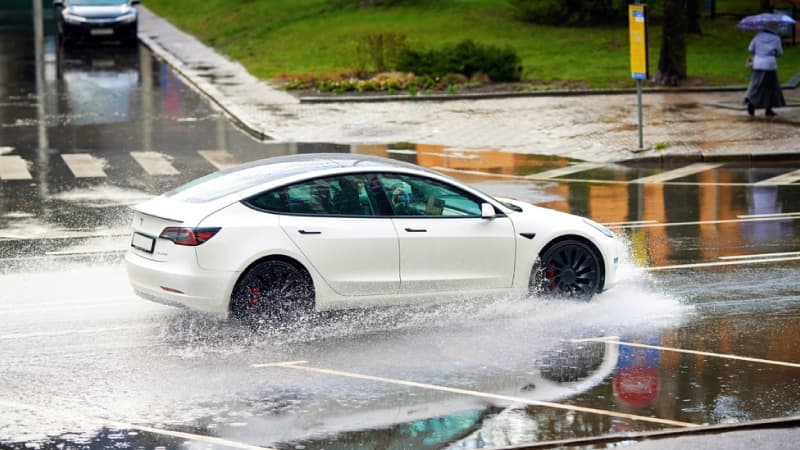
If you encounter unavoidable shallow flooding use the following steps to reduce risk:
- Check the water depth first. Look at other cars or observe roadside objects to estimate depth. Avoid guessing.
- Use slow, steady acceleration. In an EV, torque comes instantly. Apply only light pressure to avoid splashing water upward.
- Keep moving without stopping. Maintain a slow and steady pace. Stopping may let water enter areas that normally stay dry.
- Avoid driving too close to trucks or vans. Large vehicles create waves that can push water into your EV’s lower components.
- After exiting the water, test your brakes. Brake performance may be temporarily reduced after water exposure.
- Do not charge your EV immediately after driving through water. Wait for the car to dry, both for safety and to avoid unnecessary stress on the EV battery.
These steps apply to all major EV models in Thailand.
EV battery care after exposure to flood water
Even though EV batteries are sealed within IP-rated casings, routine care is essential after driving through floodwater.
What to check after a flood encounter
- Moisture around the battery casing or underbody
- Any odd smell, heat, or noise from the undercarriage
- Battery or EV system warning icons on the dashboard
- Reduced acceleration or unusual power fluctuations
If anything feels abnormal, avoid using DC fast charging until a technician has inspected the car.
When to get a professional check
Visit your service centre if:
- The water was higher than ankle level
- You drove through water for more than a few minutes
- You noticed any hesitation or alerts during or after the flood
Most Thai EV service centres offer quick diagnostic checks for water exposure.
What happens if an EV is fully flooded
Thailand occasionally experiences severe floods that can submerge entire vehicles. When this happens, high-voltage isolation systems in electric vehicles automatically activate. This safety feature stops the power flow to protect both passengers and the battery.
Despite these protections, certain components are still vulnerable to water damage. Areas most at risk include the battery management system (BMS), cooling system, control modules, motor and drivetrain electronics, as well as interior wiring and sensors.
EV insurance considerations
If the EV battery or key electronics are significantly damaged, the vehicle may be classified as a total loss. Comprehensive EV car insurance in Thailand typically covers flood damage, but owners should check:
- Flood coverage limits
- Battery replacement coverage
- Total loss procedures for EVs
Read more: Understanding loss of use in car insurance
How to prevent EV damage during Thailand’s rainy season
Flooding in Thailand is seasonal and predictable, so proactive care goes a long way.
- Choose safer parking. Park on higher ground, ramps, or indoor car parks. Avoid parking near klongs or drainage areas.
- Do not charge during heavy storms if flooding is possible. While safe in general, it’s better to avoid charging if water may rise around the parking area.
- Inspect underbody and seals regularly. Thailand’s uneven roads and speed bumps can scrape the underbody. Have your service centre check seals during routine maintenance.
- Stay updated on flood warnings. Use Thai weather and traffic apps like:
- Thai Meteorological Department (TMD)
- Traffy Fondue
- Bangkok traffic maps during heavy rain
- Adopt good EV battery habits year-round. Avoid frequent 0–100% charges and try to keep the battery between 20–80% for daily use. Use DC fast charging sparingly and park in shaded areas to reduce heat stress.
These practices help protect the EV battery long-term and make the car more resilient during the rainy season.
Final thoughts
EVs are built to handle Thailand’s unpredictable weather far better than many drivers assume. With sealed battery packs, smart safety systems, and strong waterproof ratings, they can manage everyday flooding as long as you stay within safe depths and drive with care. What matters most is knowing your limits, choosing safer routes during storms, and giving your EV a quick check after moving through water.
If you’re ever unsure about your car after heavy rain or flooding, professional inspection brings clarity and peace of mind. And for moments you can’t predict on the road, having car insurance that covers flood damage helps you recover faster and with fewer worries. Roojai’s EV car insurance helps cover flood-related damage, towing, and repairs at trusted service centres. With flexible plans and easy digital services, it’s simpler than ever to stay protected in Thailand’s rainy season and beyond.