Driving in Thailand quickly becomes part of daily life for many foreigners, but local road conditions can be very different from what most expats are used to, with dense traffic, heavy motorcycle usage, and unfamiliar driving patterns.
Roojai’s internal claims data shows that driving risks in Thailand are shaped less by rare, severe accidents and more by the frequency of everyday incidents. Minor collisions, low-speed impacts, and small third-party accidents occur regularly and can still lead to repair bills, liability costs, and medical expenses that add up quickly. For foreigners unfamiliar with local traffic patterns and insurance structures, these routine incidents are often underestimated. This makes car insurance an important consideration when driving in Thailand, even though only basic coverage is legally required.
Is car insurance mandatory in Thailand?
Yes, all vehicles driven on public roads in Thailand are legally required to have compulsory motor insurance, commonly referred to as Por Ror Bor. This basic government-mandated coverage provides limited protection for bodily injury and medical expenses resulting from road accidents. However, coverage limits are relatively low and may not be sufficient for major accidents, vehicle damage, or third-party liability claims. Because of these limitations, many drivers in Thailand also purchase voluntary motor insurance for broader protection.
Voluntary car insurance in Thailand can help cover:
- Damage to own vehicle
- Third-party property damage
- Theft and fire
- Flood damage
- Roadside assistance
The type of protection available depends on the policy level selected. Type 1 insurance generally provides the most comprehensive protection and is commonly chosen by foreigners who own newer vehicles, drive frequently, or want broader financial protection against accidents and repair costs.
What claims data reveals about foreign drivers in Thailand
Internal claims data from non-Thai policyholders provides useful insight into the types of incidents foreigners most commonly experience on Thai roads. Based on motor-related claims submitted by foreign policyholders between 2025 and year-to-date 2026, collision-related incidents accounted for the largest share of internal combustion engine (ICE) claims overall, followed by self-accidents, third-party property damage, and windscreen claims. With claim frequency at around 33%, or roughly one claim every three years, the data highlights how frequently these incidents occur among foreign drivers.
Key insights from foreign driver claims (2025–2026)
- Claim frequency for foreign policyholders is around 33% (1 claim every 3 years)
- 73% of ICE claims linked to collisions with third-party and self-accidents
- Third-party damage accounts for 18% of total claims
- Average EV repair cost is about 40% higher than ICE repair cost
- High-severity claims, such as theft and flood damage, can result in significantly higher costs per case
Collisions account for the majority of claims
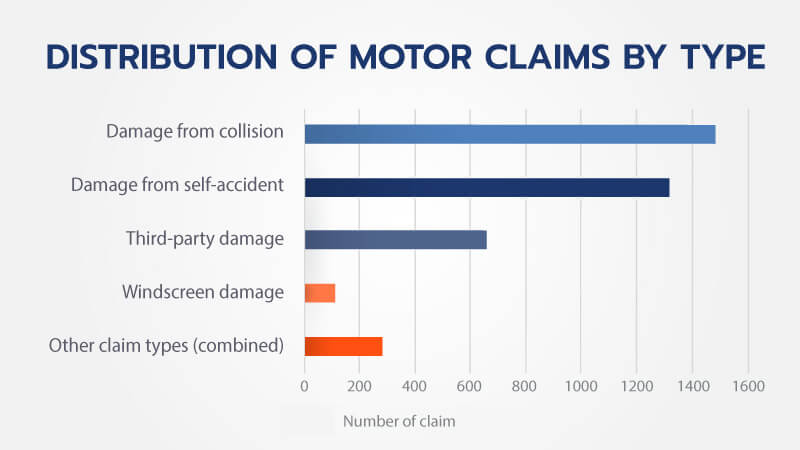
Vehicle collisions and self-accidents made up over 73% of all ICE claims, with more than 2,800 cases recorded out of 3,854 total claims during the period analysed.
Collision claims alone accounted for approximately 38% of all cases, with 1,485 claims, while self-accident, defined as single-vehicle or own-damage incidents, contributed around one-third. Collision claims tend to be slightly more expensive on average than self-accidents, although both remain within a similar mid-range band.
This indicates that risk for many foreign drivers is driven more by frequency than severity. Routine incidents such as minor collisions and low-speed impacts occur often, and while individually small, their repair costs can add up quickly over time.
Third-party damage remains a significant financial risk
Third-party property damage claims also represented a substantial share of claims submitted by foreign policyholders. In the observed dataset, these claims accounted for roughly 18% of total motor claims, with over 700 cases recorded, making this one of the most common claim types after collision and self-accident events.
In terms of costs, claims involving damage to other vehicles are slightly lower than standard collision claims (around 9% lower than average), while damage to other types of property is approximately 23% lower. However, average figures alone do not fully capture the risk. Costs can escalate quickly in more complex scenarios, particularly in multi-vehicle accidents, where total claim costs can be several times higher than a typical single-incident collision.
This is particularly important because compulsory insurance in Thailand provides limited protection for third-party vehicle and property damage. In many situations, drivers may still be financially responsible for repair costs involving other vehicles or roadside property involved in an accident.
Less frequent claims can result in much higher costs
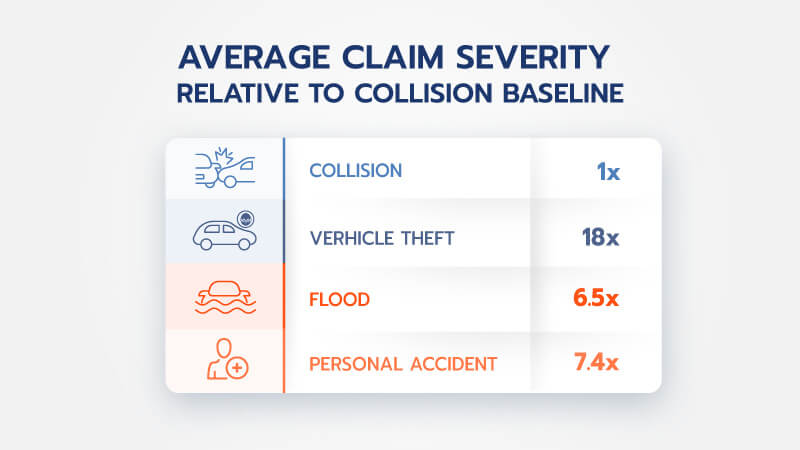
Although less common overall, certain categories showed significantly higher average claim values than standard collision-related incidents. For context, a typical collision claim serves as a baseline, but several lower-frequency categories exceed this by a wide margin:
- Vehicle theft claims were over 18x higher on average
- Flood and natural disaster damage was approximately 6.5x higher per claim
- Excess third-party bodily injury claims were around 10x higher on average
- Personal accident coverage for drivers was roughly 7.4x higher per case
While these events typically represent less than 1 to 2% of total claims each, their financial impact is disproportionately high, as a single high-severity event can create substantial out-of-pocket costs without sufficient insurance coverage.
Flood-related claims offer a clear example. During Thailand’s rainy season, heavy rainfall and water accumulation in certain areas can result in severe vehicle damage, particularly in flood-prone areas. Repair costs from water damage often exceed those associated with standard collision claims by several multiples.
While most claims are relatively small and frequent, a single high-severity event can create substantial out-of-pocket costs without sufficient insurance coverage.
EV claims showed higher average repair costs
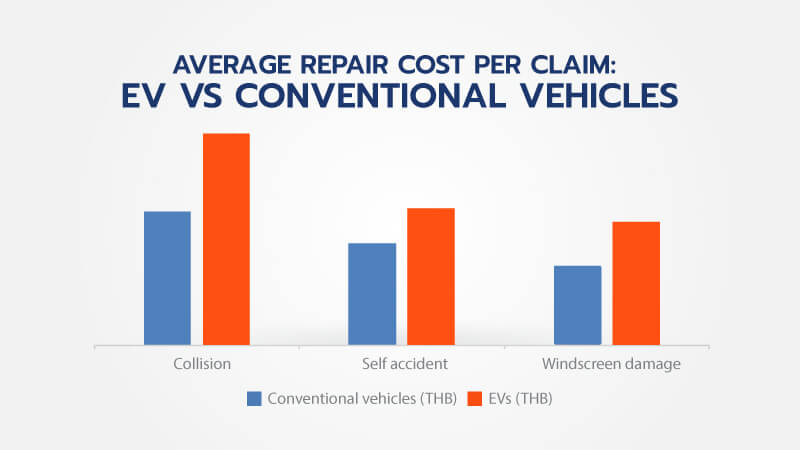
EV claims from non-Thai policyholders represented a relatively small portion of total activity but showed consistently higher repair costs compared to conventional vehicles. During the period analysed, there were 164 EV claims compared to 3,854 claims involving conventional vehicles, representing roughly 4% of total claim volume.
Given the difference in claim volume, focusing on average cost per claim allows for a clearer comparison of repair severity across similar incidents.
On average, EV claims cost about 40% higher than ICE claims. This difference becomes more apparent when comparing similar types of claims:
- Collision-related EV claims were around 60% higher on average compared to conventional vehicles
- Windscreen-related EV claims were approximately 55% higher than those for conventional vehicles
These comparisons show that even routine incidents tend to be more expensive to repair when EVs are involved. This reflects higher component costs, more complex repair processes, and a still-developing EV repair ecosystem in Thailand.
Although EV claims remain much less frequent than conventional vehicle claims, the data highlights an important consideration for foreign drivers. Repair costs can escalate quickly even after minor incidents, making comprehensive insurance increasingly important as EV adoption grows.
What this means for foreigners driving in Thailand
The data reveals a clear pattern that most risks on Thai roads are not catastrophic events, but frequent everyday incidents that can still lead to meaningful repair and liability costs over time. Collisions, self-accidents, and third-party damage account for the majority of claims, while less frequent events such as theft, flooding, and bodily injury tend to result in significantly higher claim values when they occur.
For foreign drivers, this combination of high frequency and occasional high severity is important to understand. Even experienced drivers may face minor accidents due to unfamiliar road conditions, dense traffic, and the presence of motorcycles in everyday driving. Without sufficient coverage, these costs can quickly accumulate or, in more serious cases, become financially burdensome.
Compulsory insurance provides a basic level of protection, but it is not designed to cover vehicle repairs or substantial third-party damage. As a result, many foreigners choose additional voluntary coverage, particularly if they drive regularly, own newer vehicles, or want broader financial protection against unexpected costs.
Definitions:
| SatNav | navigation system that is based on satellite data |
| Extreme sports | sporting events or activities that have common characteristics of high speed and high-risk |
| Personal injury | a form of injury affecting a person’s body as defined in the personal accident insurance policy |